
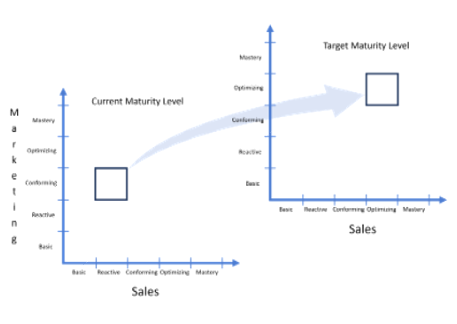
A sales and marketing maturity assessment measures the capability level of your commercial organization, category by category, and positions it on a defined scale rather than just an opinion. SM3 does this for both functions at once. A group of people from your business answers the same questionnaire independently. Every category is scored and positioned on a five-level scale, from basic to mastery; the result is compared with average performance and best practices, and the gaps between the two functions are made visible. You learn three things: where you stand, how that compares with similar businesses and best practices, and which areas need to be addressed first to improve your commercial performance.

What the assessment measures
SM3 assesses your organization’s performance against the 26 underlying pillars of commercial capability, 12 on the sales side and 14 on the marketing side. For the summary reports, these are grouped into seven sales categories and nine marketing categories, which is the level at which you read your results. The SM3 effectiveness framework explains how the model is structured.
The sales categories cover strategy, process automation, routes to market and partner channels, culture and communication, recruitment, training, and leadership.
The marketing categories cover strategy and plans, branding, market awareness, market segmentation, communications, competitive analysis, marketing technology, staff selection and development, and product & offer management.
The underlying pillars support these categories and drive the scoring. The categories are how your results are presented back to you.

The five levels
Each category is evaluated on the same five-level scale, defined in the glossary. In the reports, sales levels are labelled 1 to 5 and marketing levels A to E. It is the same framework in both cases, just with different labels.

Basic. The lowest level, and in practice a lack of maturity. The overall commercial system may function, but it has no sophistication and is both inefficient and ineffective.

Reactive. Where the journey to maturity usually starts. The business runs as a series of self-supporting units, reacts fairly well to change but is behind the curve on modern methods. Automation is outdated, and spreadsheets are abundant.

Conforming. The middle of the scale. An average, reasonably well-run business that performs adequately, though sales and marketing may still operate largely separately from one another. This is currently the highest level most organizations have reached.

Optimizing. For many businesses, the highest level they will want to achieve. A very well-functioning organisation that knows what it is doing, is effective and efficient, coordinates across functions, makes real use of automation and AI, and meets its targets consistently.

Mastery. The highest level, and one some businesses aspire to. Excellence at everything they do, agile in a changing world, and an example to others.
Using one scale across both functions is what makes the comparison possible. A marketing score and a sales score produced by different models cannot be compared to each other. These can.

How alignment is actually measured
Most content about sales and marketing alignment describes what good and bad look like and stops there. SM3 scores it.
Alignment is measured directly through questionnaire items covering six things: the relative performance level of sales against marketing, how often the two functions meet together, how useful those meetings are, the level of informal contact and practical support between them, whether strategic planning is done jointly or separately, and how much input each function receives from the other when planning.
There is a second layer. Because respondents answer independently, the summaries also carry consistency indicators against your scores. A business can score reasonably on a category while its own sales and marketing people hold different views about whether it does. The opposite can also happen: teams who believed they were at odds turn out to be aligned, describing the same objectives in different operational language. Either way, capability isn’t always the issue. Shared understanding often is.
Confidentiality and what is being assessed
Two points matter before you choose your respondents.
Individual answers are not shared inside your business. Nobody sees how any individual answered. The report describes the business, not the people who completed it.
SM3 assesses organizational capability, not individual skill. It is not a performance review, and nothing in the report evaluates any individual.
This is what allows people at different levels to answer candidly, and candid answers are what make the results accurate.
Where the benchmarks come from
The report positions you against two reference points: average performance and best practice.
Both are drawn from research rather than from a database of previous customers. The model draws on published professional standards, research from major consultancies and industry commentators, input from 20 advisors across 8 countries, and decades of direct B2B operating experience from the people who built it. Sector and geographic weightings refine your scores against research-based worldwide averages and best-practice measures.
SM3 constructed its own measures using publicly available information from the professional bodies alongside other sources. Whilst many of the advisors are members of various professional bodies, SM3 is not directly endorsed by the Chartered Institute of Marketing or the Institute of Sales Professionals.
You are being measured against what good looks like in the profession, not against a sample of whoever happened to buy the product before you.
How the assessment runs
Step one: your respondents. A group spanning both functions. From three to fifteen, with five being the typical ‘sweet spot’. The most useful results come from a mix of seniority and perspective: a sales professional and a marketing professional, a sales manager and a marketing manager, and someone at board level. Their job role carries a weighting in the scoring. Who the assessment is for covers how to choose them.
Step two: the questionnaire. Each person answers the same 32 questions independently, taking 20 to 30 minutes. Answers are given on a sliding scale rather than a short list of fixed options, which removes the usual problem of being stuck between two levels. No preparation. No data pull. No workshop to schedule.
Step three: scoring. Responses are processed by a number of weighted algorithms that take account of job role, market sector and geography. How the SM3 system works sets out each step.
Step four: your report. The finalized report will be delivered back to you typically within two working days.
The questionnaire and the report both run in English, French, Spanish, German and Dutch, so a respondent can answer in one language while the business reads the report in another. (Reports can be delivered in more than one language at no additional cost)
Optional support. Free pre-survey briefing and free post-survey interpretation session, if requested.
What you learn
Where you stand. A maturity level for every category, on both sides of the business, presented graphically. What the output looks like shows real examples.
How that compares. Each category is set against average performance and best practice, so you can tell the difference between a weakness and a serious challenge.
Where to focus first. Effort spent on the wrong area is the most common waste in commercial improvement, because businesses tend to act on the most visible problem rather than the one holding them back the most. How to use your assessment results covers what businesses do next, and Stop Losing Money Today sets out the commercial case for acting on them.
What a sample report looks like
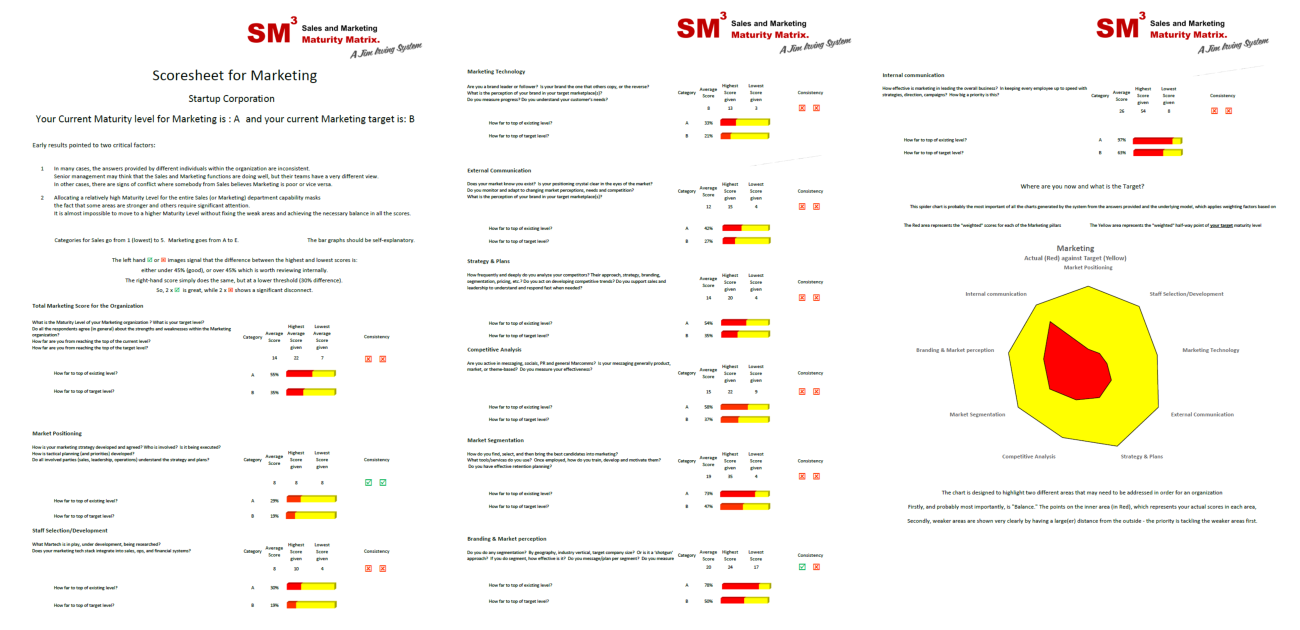
In this sample, sales process automation has an average score of 35, with individual responses ranging from 15 to 46. The score tells you the capability level. The spread tells you how much the people inside the business agree or disagree about it. Those are two separate findings, and the second is often the more useful one.
The spider chart on each summary compares your actual scores against a target maturity level.
This is a sample report for an example company, included to show what the output looks like. It is not a customer result. What the output looks like shows the full set.
What it costs, and what the alternative costs
| QuickScan | Full Matrix Report | |
|---|---|---|
| Price | $765 | $2,600 |
| Format | Three-page sales summary and three-page marketing summary | Both summaries plus a detailed report of more than 60 pages |
| Maturity level per function | Yes | Yes |
| Category level scores | Yes | Yes |
| Consistency indicators | Yes | Yes |
| Progress towards current and target levels | Yes | Yes |
| Detail provided | Category level scores and graphical summaries | Detailed explanation of the model, the findings behind each score and recommended next steps |
| Compared against average and best practice | Summary level | Full |
For comparison, we have been quoted $20,000 to $45,000 for an equivalent audit of both functions by a consultancy, running over several weeks or months.
The difference is not only cost. A consultancy audit produces a bespoke document and, in most cases, an attached proposal. SM3 produces a validated position you own outright, with no engagement to decline at the end of it. What SM3 is not explains why the product was built this way.
You can buy the QuickScan or the full Maturity Matrix Report directly, or compare the two report options side by side first.
Common questions

A structured measurement of how capable a business is at the activities that generate revenue, scored against a defined scale rather than judged by opinion. A commercial maturity assessment covers both sales and marketing, because revenue depends on both. SM3 assesses 26 underlying pillars across the two functions, grouped into seven sales categories and nine marketing categories, and places every category on a five-level scale from basic to mastery.
32 questions, taking 20 to 30 minutes per person. Nothing needs to be prepared in advance.
People from both sales and marketing with enough visibility to answer accurately about how the functions run, ideally including someone at board level. They should answer separately rather than agree on responses first, because differences between their answers are part of the result.
No. Responses are confidential, and the assessment measures the organization rather than the individuals within it.
The finalized report is typically with you in under two working days.
English, French, Spanish, German and Dutch. Both the questionnaire and the report are available in all five languages, and respondents can answer in one language while the business receives the report in another.
The QuickScan gives you a three-page summary for each function, with category-level scores, consistency indicators and graphical summaries. The full report gives you both summaries plus a detailed report of more than 60 pages explaining the model, the findings and the recommended next steps. Compare the two report options.
No. SM3 was built to stand on its own. There is no consulting engagement behind it, and the report does not route you towards buying one.
A marketing maturity model assesses one function. It can tell you your marketing is weaker on competitive analysis, but not whether sales is weaker still, or whether the two functions agree on what is happening. SM3 measures both on the same scale and shows where they diverge. What is a maturity matrix explains the underlying method.
Further questions are answered in the full FAQs, or you can ask us directly.