The Sales and Marketing Maturity Assessment That Shows You Where to Focus Next
The Sales and Marketing Maturity Matrix (SM3) tells you where your sales and marketing capability stands today, how that compares to the average and to best practice, and which areas need attention first. A group of people from your business answers the questionnaire independently and anonymously, and the report scores sales and marketing on the same scale, side by side. You see not only how each function performs, but how well the two work together as one revenue engine. SM3 is a self-service assessment built by practitioners. It is not a lead generator for a consulting service.

Basic capability

Reactive

Conforming

Optimizing

Mastery
Who built it
SM3 is the work of Jim Irving and Norman Manley, supported by twenty advisors from eight countries across three continents. It took more than two person-years to build.
Jim is a long-standing Fellow of the Chartered Institute of Marketing (FCIM) and a Founding Fellow of the Institute of Sales Professionals (FF.ISP), with a total of 30 years in sales and marketing leadership across 25 countries and three award-winning books behind him. Norman is a mathematician who has spent 25+years at the C-level in sales and marketing, and built the matrix, the back-end systems and the analytics.
The reference points your results are measured against come from research rather than from a database of previous customers. The model draws on published professional standards, research from major consultancies and industry commentators, the advisory group’s input, and decades of direct B2B operating experience. Sector and geographic weightings refine your scores against research-based worldwide averages and best-practice measures.
What businesses say about the result is worth reading alongside this.
Who SM3 is for

SM3 is bought by the person accountable for revenue. That is usually a founder, CEO, managing director, commercial director, CRO, CFO or COO, most often in a mid-sized or scaling business at the point where sales and marketing have grown into two separate functions with two separate sets of assumptions.
A wider group completes it. Practitioners and departmental leaders from both functions answer the questionnaire, because they know how the work runs day to day. The person who buys the assessment and the people who complete it are normally not the same audience, and SM3 is designed for both. Who the assessment is for covers this in more detail.
The question that brings most people here is a version of the same one: we are spending on sales and marketing, so why is growth not following? Answering it means knowing which part of the operation needs work, so you can put budget and effort where they will make the most difference.

What makes SM3 different: both functions, one scale
Maturity models are not new. Measuring sales and marketing together on a single scale is.
Most assessments look at one function. You end up with a marketing score and no way to read it against sales, or the reverse. SM3 assesses 26 underlying pillars of commercial capability, 12 on the sales side and 14 on the marketing side. In the summary reports, these are grouped into seven sales categories and nine marketing categories, so you can see your strengths, weaknesses and priorities at a glance. Every category is positioned on the same five-level scale, from basic through reactive, conforming and optimizing to mastery.
Scoring both functions on one scale is what makes the comparison possible. When marketing scores well on brand and market awareness while sales scores lower on routes to market and process automation, you have a business generating demand it is not yet set up to convert. That is a different situation, with a different answer, from one where both functions are weaker in the same area. The SM3 effectiveness framework sets out how the model is built.
How it works
Your respondents. People from both sales and marketing complete the same questionnaire independently. From three to fifteen, but five is the normal ‘sweet spot’. Answering separately is deliberate. Where answers differ, that difference is itself a finding.
32 questions, 20 to 30 minutes for each person to complete the survey. No preparation, no data gathering, no workshops to schedule.
Your answers stay confidential. Individual responses are not shared with anyone else in your business. SM3 assesses the business’s capability, not the performance of the people completing it, which lets people at different levels answer candidly.
Five languages. The questionnaire and report are available in English, French, Spanish, German, and Dutch. A respondent can answer in one language while the business receives the report in another.
Your report. Results will be back to you normally in under two working days.
How the SM3 system works sets out the full process.

What comes back
Two options, depending on the depth you need. What the output looks like shows both.
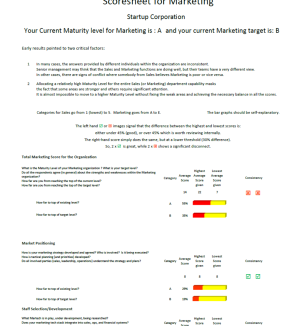
The Sales and Marketing QuickScan at $675 gives you a three-page sales summary and a three-page marketing summary. Between them, they show category-level scores for both functions, your progress towards your current and target maturity levels, consistency indicators showing how closely your own people agreed, and graphical summaries of where you stand.
The full Sales and Marketing Maturity Matrix Report at $2,600 gives you both summaries plus a detailed report of more than 60 pages, explaining the model, setting out the findings behind each score and recommending your next steps.
Compare the two report options both side by side, and the brochures give you more to take away.
Common questions
Twenty to thirty minutes per person for the questionnaire. There is no preparation required and no data to assemble beforehand.
A spread of people across both functions. The most useful results come from a mix of seniority: a sales professional and a marketing professional, a sales manager and a marketing manager, and someone at board level. Job role carries a weighting in the scoring, and respondents answer independently rather than agreeing a response as a group. Who is it for covers how to choose them.
No. Individual responses are not shared within the organization. The report describes the capability of the business, not the performance of individuals.
No. SM3 exists as a product in its own right, and the report does not route you towards a consulting engagement. At the client’s request, Jim will run a 30-minute pre-briefing session online, and/or a walk-through of the results, also for 30 minutes. [Optional briefing and interpretation support, if confirmed.] What SM3 is not is explicit on this point.
That is useful information rather than a problem with the questionnaire. The summaries carry consistency indicators, so you can see where your own people hold different views of the same business. Where views differ, it usually points to an area where shared understanding could be stronger and should be improved.