
Sales and marketing maturity is described in five stages. In the SM3 model they are Basic, Reactive, Conforming, Optimizing and Mastery. Basic is in practice a lack of maturity: the system may function, but without sophistication. Reactive is where the journey often starts, with self-supporting units that react fairly well but sit behind the curve. Conforming is an average, reasonably well-run organisation, where sales and marketing may still operate largely separately; it is currently the highest stage most organizations reach. Optimizing is effective, efficient and coordinated across functions, and for many businesses the highest stage they will want to achieve. Mastery means excellence throughout. It is literally ‘best in class’. Most businesses sit at different stages in different areas, so knowing your stage level category by category matters more than a single overall score.


Basic capability

Reactive

Conforming

Optimizing

Mastery
What is marketing maturity?
Marketing maturity describes how capable a marketing function is, measured against defined stages rather than by activity or spend. A mature marketing function has a strategy built from the business plan, a clear brand position, defined segments, consistent communications, useful competitive insight, technology that supports it all, and close collaboration with sales. Sales maturity describes the same thing for the sales function.

Stage one: Basic
In plain terms: the work gets done, without structure. Basic is the lowest level and, in practice, reflects a lack of maturity. The system may function, but it has no sophistication and is both inefficient and ineffective.
What it tends to look like: results depend on individuals, selling follows each person’s habits, and marketing is a set of activities rather than a plan.
Moving up means documenting how the work gets done, so it depends less on who happens to be doing it.

Stage two: Reactive
In plain terms: reasonably OK at responding, but with less time for planning. This is where the journey to maturity usually starts. The business runs as a series of self-supporting units, reacts reasonably well to change but sits behind the curve on modern methods. Automation is outdated, and spreadsheets are typically abundant.
What it tends to look like: sales and marketing each work energetically in their own way, tools are bought to solve specific problems, and plans are often overtaken by events.
Moving up means planning ahead of events, and agreeing shared definitions between functions.

Stage three: Conforming
In plain terms: a reasonably well-run, average organization. It performs adequately, though sales and marketing may still operate largely separately from one another. This is currently the highest level most businesses reach.
What it tends to look like: a documented plan, systems people use, and reporting that works, with the two functions meeting to exchange updates more than to plan together.
Moving up means bringing the two functions together and using information to decide what to do next, as well as to report what happened.

Stage four: Optimizing
In plain terms: it knows what it is doing. A well-functioning organisation that is effective and efficient, coordinates across functions, uses automation and AI effectively, and meets its targets consistently. For many businesses, this is the highest level they will want to achieve.
What it tends to look like: sales and marketing planning together, automation and AI applied to defined processes, and targets met as a matter of routine.
Moving further is a choice. For many businesses, reaching this stage in the areas that matter most is their goal.

Stage five: Mastery
In plain terms: the example others follow. Excellence in everything it does, agility in a changing world, and a model for others to mimic. Some organizations aspire to this level, often in the areas that define their competitive edge.
What are the stages of sales maturity?
The same five stages apply to sales, assessed across seven sales categories: strategy, process automation, routes to market and partner channels, culture and communication, recruitment, training, and leadership. In SM3 reports, sales levels are labeled 1 to 5. Sales process automation maturity applies the stages to one of those categories in depth.
Marketing maturity levels explained
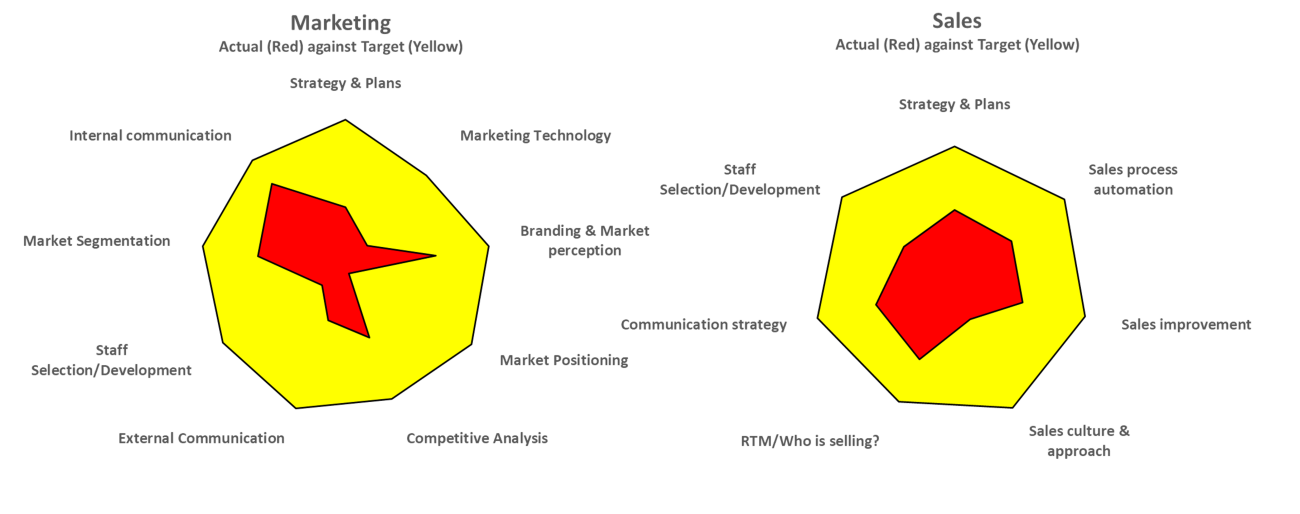
Marketing uses the same five stages, labeled A to E in SM3 reports, so they can be told apart from sales. They are assessed across nine marketing categories: strategy and plans, branding, market awareness, market segmentation, communications, competitive analysis, marketing technology, staff selection and development, and product & offer management. The labels differ between marketing and sales; the definitions are the same, which allows direct comparison between sales and marketing.
Can a business be at different stages in different areas?
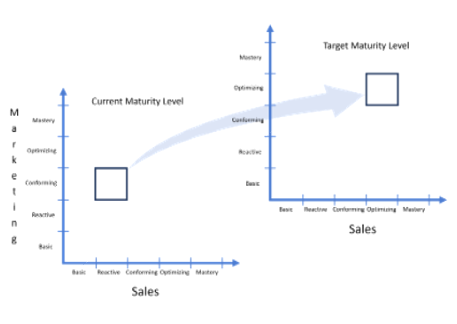
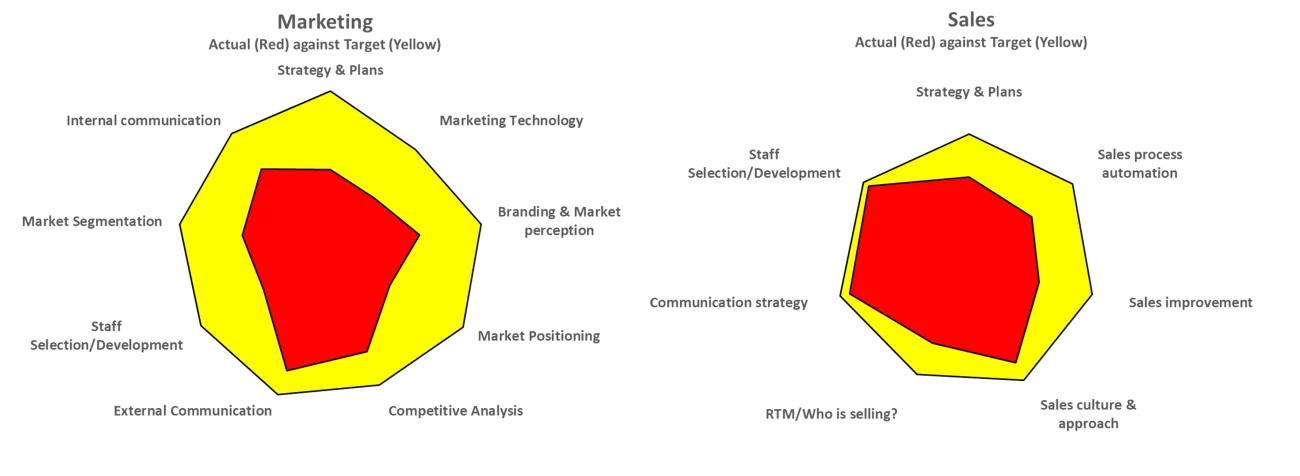
Yes, and it is normal. Marketing might be Conforming on branding and Reactive on marketing technology, while sales is Optimizing on leadership and Basic on process automation. A single stage for the whole business would hide exactly the information you need in order to decide where to focus and act. That is why SM3 places every category on the scale separately, for both functions.
Which stage should we aim for?
Not Mastery everywhere. For many businesses, the most useful target is Optimizing in the categories that drive their growth. Moving one stage in the right category usually does more than moving several in the wrong one.

How long does it take to move up a stage?
It depends on the category, the starting point and the effort put in. Some moves mainly involve writing down and agreeing what already happens; others need sales and marketing to change how they work together. Measuring again after a planning cycle is a reliable way to know.
How mature is your marketing, and your sales?
You can form a view from the descriptions above, but people inside a business naturally judge from where they sit, and a sales director and a marketing director describing the same company capabilities can land on different stages. The sales and marketing maturity assessment asks people from both functions the same questions independently and confidentially, then places each category on the scale and shows how closely the respondents agree. What is a maturity matrix? explains the method.

Common questions

Basic, Reactive, Conforming, Optimizing and Mastery, in the SM3 model.
Conforming is currently the highest level most organizations reach, and Reactive is where the journey usually starts.
No. It describes an average, reasonably well-run organisation that performs adequately. It is the base from which sales and marketing can be joined up.
Yes. Sales levels are numbered 1 to 5 and marketing levels lettered A to E in SM3 reports, but the definitions are identical.