
A proper sales and marketing audit assesses both functions against a defined standard, covering strategy, process, people, technology, routes to market, brand and leadership, then examines how well the two functions work together. It gathers views from multiple people at different levels and rates the findings on one scale, so you can tell whether an area is weaker for a business like yours or genuinely behind. The easiest parts to miss are the connection between sales and marketing, the level of agreement among the people who do the work, and a clear standard to measure against. A structured self-service assessment like SM3 is a practical way to audit both functions without the cost or time of a consultancy engagement.

What does a sales and marketing audit include on the sales side?
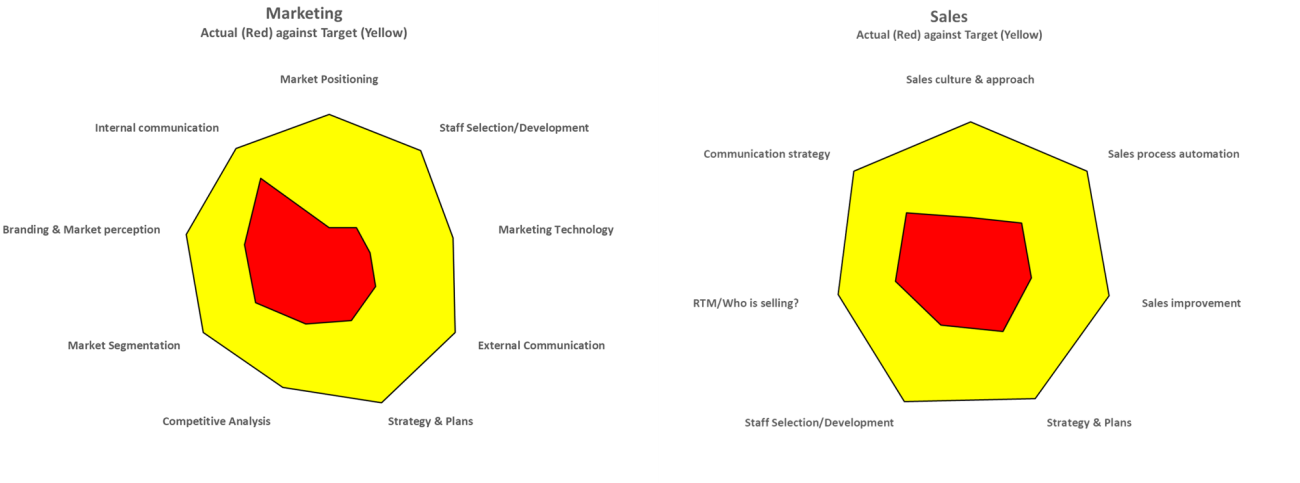
Strategy. A written sales strategy tied to the business plan, with defined target customers and priorities. Plus the frequency of review and amendments.
Process automation. A defined process that is followed, supported by connected systems working from one version of the truth, including how AI is used. Sales process automation maturity covers this in depth.
Routes to market and partner channels. Routes chosen deliberately and managed so they support each other. Routes to market and channel strategy sets out what to look for.
Culture and communication. How salespeople work with each other and with the rest of the business.
Recruitment. How the business finds and selects salespeople.
Training. Whether salespeople are developed in a professional and defined way.
Leadership. How sales is led, coached and held to account.
What does a marketing capability audit include?
Strategy and plans. A marketing plan built from the business strategy.
Branding and market awareness. A defined brand position applied consistently, and a real understanding of the market. Brand and market awareness assessment goes further.
Market segmentation. Defined groups with shared needs, with marketing planned to them.
Communications. Messages consistent across channels and matched to each segment.
Competitive analysis. Competitor information gathered systematically and shared with sales.
Marketing technology. Tools adopted, integrated and used to make decisions. Is your martech stack working? covers this.
Staff selection and development. How marketing people are recruited and developed.
Product & offer management.
The part that is easiest to miss: the connection
Some of the most important commercial issues sit between the two functions rather than inside either. A full audit should cover:
- whether sales and marketing share definitions of customer, prospect, qualified lead and revenue
- whether planning is done jointly or separately
- how often the functions meet, and how useful those meetings are
- the level of informal contact and practical support between them
- how much input each function has into the other’s plans
- the relative performance level of sales against marketing
These are the alignment questions SM3 asks directly. Sales and marketing alignment explains why they matter.
What else should an audit include?
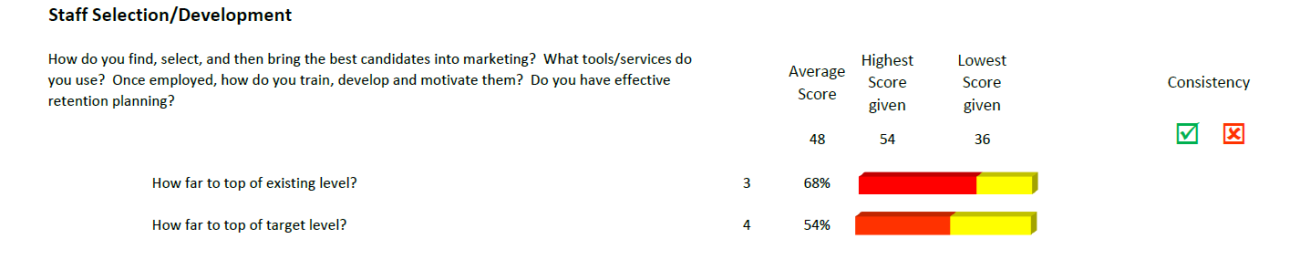
A defined standard. Defined levels turn a list of observations into a position, with a clear view of how far an area is from the next level up.
More than one view. The people doing the work day to day often see something differently from the leadership team. Independent answers from several levels capture both.
The level of agreement. When several people answer independently, the spread of their answers is itself a finding. A category can score reasonably while respondents see it very differently, which points to shared understanding as the core thing to address.
Confidentiality. People answer more candidly when their individual responses are not shared, and when the audit assesses the organization rather than their personal performance.
The outside view. Sales and marketing are changing quickly, including through AI. The full SM3 report includes a section on the trends affecting sales and marketing worldwide.
How to run a sales and marketing audit
- Decide the scope: both functions and the connection between them.
- Choose respondents from both functions and several levels: ideally a sales professional, a marketing professional, a sales leader, a marketing leader and someone at board level.
- Have each person answer the same questions independently and confidentially.
- Place every category on a defined maturity scale and compare it with average and best practice.
- Look at where respondents disagree as well as where scores are lower.
- Choose the categories where moving one level would make the biggest difference to growth.
- Repeat after a planning cycle to measure progress.
SM3 handles steps two to five. A group of your people, [minimum 3, recommended 5], answers 32 questions in 20 to 30 minutes each, with no preparation. How the SM3 system works covers the process.
Sales capability assessment
If your immediate focus is the sales team, a sales capability assessment concentrates on the seven sales categories above. It is still worth running alongside marketing: a capable sales team can underperform if the leads it receives or the routes it sells through need attention. SM3 assesses both functions together, on the same scale.
How long does a sales and marketing audit take, and what does it cost?
A consultancy audit of both functions has been quoted to us at $20,000 to $45,000, running over several months. With SM3, each respondent needs 20 to 30 minutes, followed by [turnaround commitment per report option]. The full report costs [price] and the QuickScan [price]. Self-service assessment or a consultancy? sets out the honest trade-offs.
Common questions

A structured review of how capable a business’s sales and marketing functions are, individually and together, measured against a defined standard rather than opinion.
Strategy, process automation, routes to market and partner channels, culture and communication, recruitment, training and leadership, plus how sales works with marketing.
A measure of how capable the sales function is across its core categories, placed on a defined scale. SM3 includes one, alongside a marketing assessment on the same scale.
Yes, if the audit uses a defined standard and several independent views. A checklist completed by one person rarely provides either; a structured self-service assessment does.
Once a year is a sensible rhythm, so each audit measures progress against the last.