
SM3 benchmarks sales and marketing together, against two reference points at once: average performance and best practice. SM3 evaluates every category on both sides of the business against a five-level maturity scale, compares it with research-based worldwide averages and best-practice measures, and further refines it with market sector and geographic weightings. That answers the question most leadership teams struggle to answer with confidence: Is this area weaker for a business like ours, or are we genuinely behind? The reference points are built from published professional standards, research and expert input, not from a pool of previous customers, so you are measured against what good looks like in the profession.

How to benchmark your commercial organization
There are two kinds of benchmarks, and the difference matters.
Outcome benchmarks compare results: conversion rates, cost per lead, win rates, sales cycle length. They are useful for telling you that something needs attention. They rarely tell you why. A lower win rate might come from qualification, lack of sales training or coaching, the route to market, or the leads marketing passes on, and two businesses with the same win rate can need completely different responses.
Capability benchmarks compare the things underneath the outcome: how mature each part of the commercial operation is. They show where the cause sits, which makes them the more useful benchmark when the decision in front of you is where to spend budget and effort next. That is what a maturity assessment provides.

What does best-in-class sales and marketing look like?
The SM3 levels are defined in advance, so what good looks like is set out rather than left to opinion.
| Level | In short | Where it sits |
|---|---|---|
| Basic | The system may function but has no sophistication; inefficient and ineffective | A lack of maturity |
| Reactive | Self-supporting units; reacts fairly well but behind the curve; spreadsheets abundant | Where the journey usually starts |
| Conforming | An average, reasonably well run organization; sales and marketing may still operate largely separately | The highest level most organizations reach |
| Optimizing | Effective and efficient, coordinates across functions, real use of automation and AI, meets targets consistently | For many, the highest level they will want to achieve |
| Mastery | Excellence at everything, agile in a changing world, an example to others | The level some organizations aspire to |
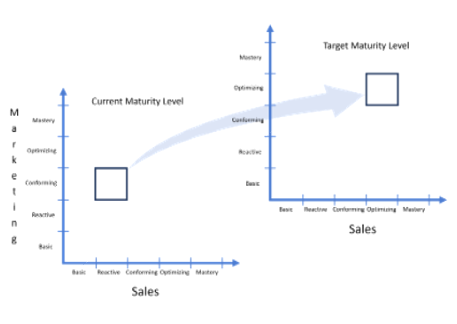
Two points follow. Conforming is a respectable result: it describes an average, reasonably well-run organisation. And Mastery is not the right target for every category. For many businesses, the useful aim is Optimizing in the areas that matter most to their growth. The stages of sales and marketing maturity describes each level in plain language.
Where do the SM3 benchmarks come from?
A benchmark is only as credible as its source. A benchmark built from a vendor’s own customer base tells you how you compare with whoever bought the product before you.
SM3 uses research instead. The model draws on:
- published professional standards and publicly available material from the professional bodies
- research from major consultancies and industry commentators
- the input of twenty advisors from eight countries across three continents
- decades of direct B2B operating experience from the two authors, one a Fellow of the Chartered Institute of Marketing and a Founding Fellow of the Institute of Sales Professionals
SM3 constructed its own measures using publicly available information from the professional bodies alongside these other sources. While many of the advisors are members of the Chartered Institute of Marketing or the Institute of Sales Professionals, SM3 is not specifically endorsed by either body.
How do I know if my results are normal for a business like mine?
Sector and geographic weightings refine the scores against research-based worldwide averages and best-practice measures. The job role also carries a weighting, because a board member and a sales professional see the same business from different perspectives. The result is a comparison that reflects where you operate and who answered the questionnaire.
How does my sales team compare to the industry average?
For many buyers, the sales side is the first thing they want to benchmark, and a sales process maturity assessment is often the starting point. SM3 assesses seven sales categories: strategy, process automation, routes to market and partner channels, culture and communication, recruitment, training, and leadership. Each is placed on the five-level scale and compared with average performance and best practice. Sales process automation maturity goes into the process and systems side in depth.
Why benchmark sales and marketing together?
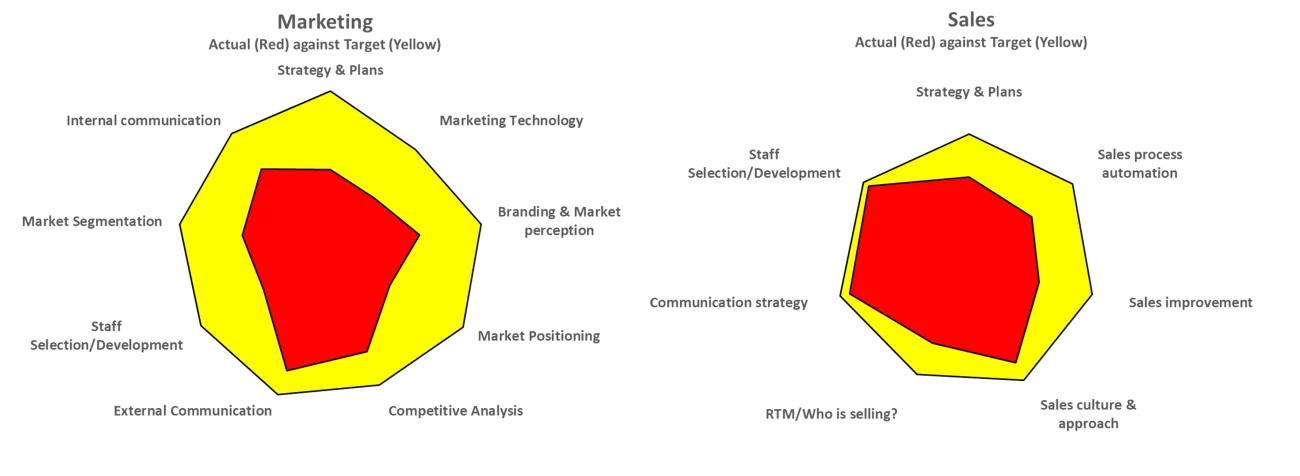
Benchmarking the two functions separately produces two numbers based on different models, so you can’t compare them. SM3 places both on the same scale, so the benchmark shows three things: how sales compares with best practice, how marketing compares, and how the two compare with each other. The third view is often where growth is being held back. Sales and marketing alignment explains why.
How benchmarking works in practice
A group of people from sales and marketing, minimum 3, recommended 5, maximum 15, answer the same 32 questions independently, in 20 to 30 minutes each. Their answers stay confidential. The summaries then show, for every category:
- your maturity level
- your progress towards your current and target levels
- consistency indicators showing how closely your people agreed
- how that compares with average performance and best practice, at summary level in the QuickScan and in full in the full report
What the output looks like shows sample pages. Repeating the assessment after a planning cycle turns a single benchmark into a measure of progress.

Common questions

A comparison of your marketing capability, category by category, against defined maturity levels, average performance and best practice. SM3 benchmarks nine marketing categories, including strategy and plans, branding, market segmentation, communications and marketing technology.
A structured measure of how mature your sales process is, from strategy through automation to leadership, placed on a defined scale. SM3 does this across seven sales categories and scores them on the same scale as marketing.
No. The reference points come from research and professional standards, refined by market sector and geography, rather than from a database of previous customers.
For many businesses, Optimizing is the category that matters most to growth. Conforming describes a reasonably well-run organisation, and Mastery is the level some businesses aspire to in the areas that define their edge.
No. It draws on publicly available material from the professional bodies, and many of its advisors are members of them, but SM3 is not specifically endorsed by either.