
A maturity matrix is a structured way of measuring how capable an organization is in a particular discipline. It breaks the discipline into its core pillars, the things any business must do well in that area to be successful – then places each pillar on a defined maturity scale, from a basic level where the work functions without structure to mastery. Because each level is defined in advance, the result is a position, not an opinion. You can see where you stand, which pillars are strong, which are weaker, and what the next level up looks like. The method is not new. It has been tested over decades.
How does a maturity matrix work?
There are two parts: the pillars and the levels.
The pillars define what is being measured. In any discipline, a handful of capabilities decide whether the whole thing works: strategy, process, people, technology and leadership usually appear in some form.
The levels define how well each pillar performs. A maturity scale moves from an organization that functions in a generally unstructured way, through defined stages, to one where activities are defined, managed, measured and effective, to the point that others in its sector use it as the example of how things should be done.
Questions deliver the scoring. A well-built matrix asks detailed questions about each pillar and uses the answers to position it on the scale. Where two people describing the same business land in different places, that difference is a finding in its own right.
Maturity matrix or maturity model: is there a difference?
The terms are used almost interchangeably. A maturity model is the framework of levels and the path between them. A maturity matrix applies that model across a set of pillars, so you see every pillar positioned at once. The approach grew out of the Capability Maturity Model, first used in software development, which Norman Manley explains as a framework to achieve commercial excellence.
Why most maturity models only tell half the story
Most maturity models look at a single function. That is a real limitation when two functions depend on each other.
Business intelligence is a good example. It is only effective once data cleansing and integration issues are solved, and data integration only pays back when it feeds decisions. Measure either on its own and you miss the connection that decides whether either truly works.
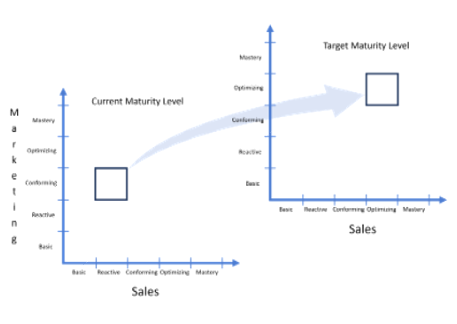
Sales and marketing work the same way. A marketing maturity model can show that marketing is weaker on competitive analysis. It cannot show whether sales is weaker still, or whether the two functions agree on what is happening. Growth depends on both capabilities being strong and on the two working well together.
How the maturity matrix applies to sales and marketing
The Sales and Marketing Maturity Matrix (SM3) applies the method to both functions at once, on the same scale.
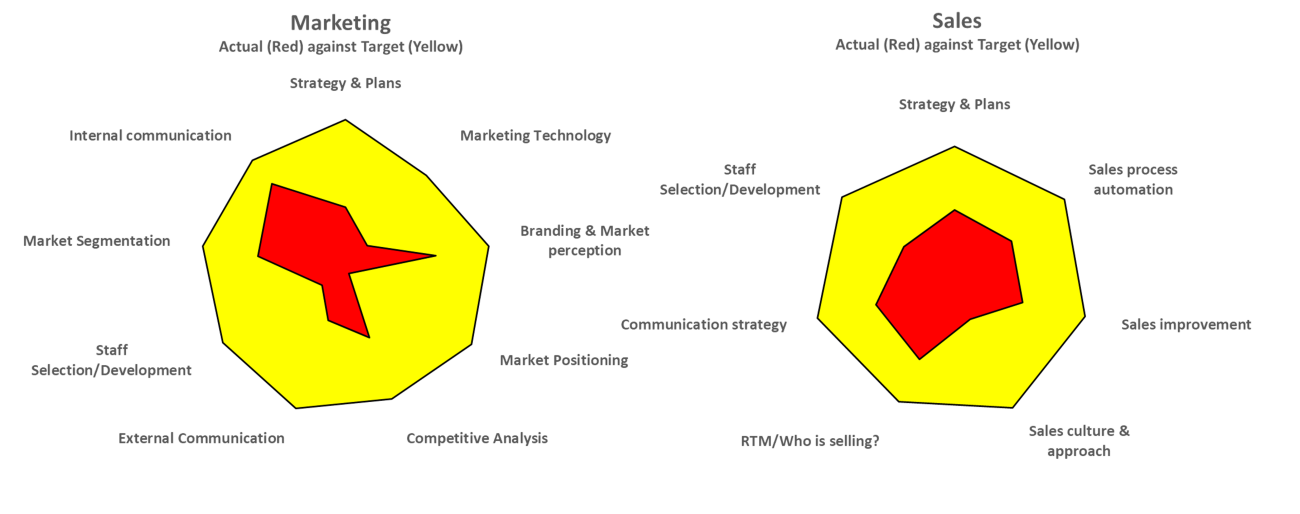
SM3 assesses 26 underlying pillars of commercial capability, 12 on the sales side and 14 on the marketing side. In the summary reports, these are grouped into seven sales categories and nine marketing categories. Each category is then positioned on a five-level scale: Basic, Reactive, Conforming, Optimizing and Mastery. The stages of sales and marketing maturity explain each level in plain language, and the SM3 effectiveness framework sets out how the model is built.
A single scale across both functions makes the comparison possible. A business whose marketing scores well on brand and market awareness while sales scores lower on routes to market is generating demand it is not yet set up to convert. That calls for a different response than when both functions are weaker in the same place, and you only see the difference when you measure both together. It is also what makes it possible to measure sales and marketing alignment rather than simply discuss it.


A marketing maturity assessment and a sales maturity model in one
Many people arrive here looking for a marketing maturity assessment or a sales maturity model. SM3 is both of them combined. The marketing categories cover strategy and plans, branding, market awareness, market segmentation, communications, competitive analysis, marketing technology, staff selection and development, and product & offer management. The sales categories cover strategy, process automation, routes to market and partner channels, culture and communication, recruitment, training, and leadership.
It is also more reliable than a sales and marketing self-assessment completed by one person. Several people from both functions and the C-Suite answer independently and confidentially, and multiple weighted algorithms score their answers rather than a self-scored checklist.
Built to help you act
Some simple maturity matrices and audits exist mainly to start a potential engagement or buying conversation. Jim Irving and Norman Manley built SM3 with twenty advisors from eight countries over more than two person-years to help businesses understand and improve their performance, for themselves. What SM3 is not sets this out.
Find out where your sales and marketing stand
If you came here to understand the concept, the next step is to see it applied to your own business. People from sales and marketing answer the same questionnaire independently, and the report positions every category on both sides of the business against average performance and best practice.

Common questions

A grid that lists the core capabilities of a discipline and shows how mature each one is, on a scale where every level is defined in advance. It turns a general sense of how well things are going into a specific position for each capability, and shows what the next level up would look like.
A framework that assesses marketing capability against defined levels, usually covering areas such as strategy, branding, communications and marketing technology. SM3 includes a full marketing assessment across nine categories, measured on the same scale as sales so the two can be read together.
A framework that assesses sales capability against defined levels, usually covering areas such as strategy, pipeline management, sales operations, and revenue technology. SM3 includes a full sales assessment across nine categories, measured on the same scale as marketing so the two can be read together.
It varies by model. SM3 uses five: Basic, Reactive, Conforming, Optimizing and Mastery. In the reports, sales levels are labelled from 1 to 5 and marketing levels A to E; the framework is the same. The glossary explains the terms used.
It can, though most do not. SM3 measures sales and marketing together, which lets you see the gaps between them.
It is self-service, in that your own people complete it without a consultant present. Unlike a single-person checklist, it gathers independent answers from several people across both functions and scores them against defined levels.
More answers sit in the FAQs.